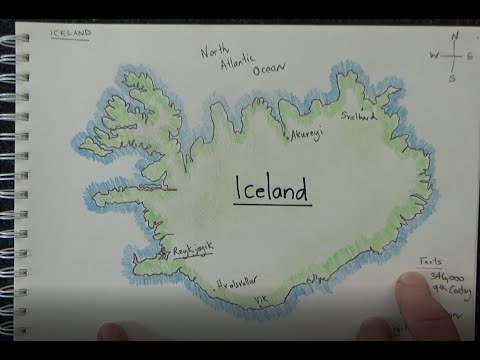
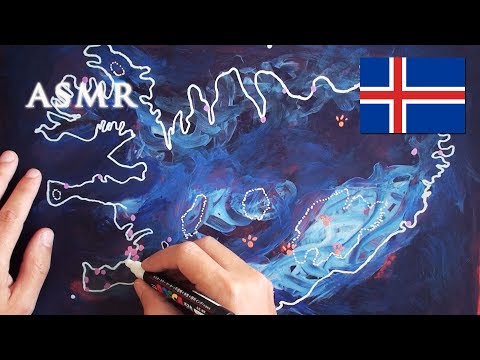
ASMR: Map of ICELAND contour tracing with facts Main CITIES less known facts ASMR maps and facts

Iceland is often referred to as the "Land of Fire and Ice" due to its unique geological features and climatic contrasts. The country’s rich cultural heritage is deeply rooted in its Viking history, with a strong tradition of literature, particularly the medieval sagas. ASMR maps and facts
#asmrfacts #asmrgeography #geographyfacts #geography #asmrwhispering #whisperedfacts
#iceland #icelandtravel #icelandtrip #icelandfacts
Iceland is a Nordic island country located in the North Atlantic Ocean, renowned for its stunning natural landscapes, which include glaciers, geysers, hot springs, and volcanoes. Covering an area of about 103,000 square kilometers (40,000 square miles), Iceland is sparsely populated, with a population of around 370,000 people. The capital and largest city is Reykjavík, which is home to nearly two-thirds of the population.
Iceland is often referred to as the "Land of Fire and Ice" due to its unique geological features and climatic contrasts. The country sits on the Mid-Atlantic Ridge, which is a tectonic boundary between the North American and Eurasian plates, making it one of the most volcanically active places on Earth. This geological activity gives rise to dramatic landscapes, including the famous Blue Lagoon geothermal spa, the powerful Gullfoss waterfall, and the Vatnajökull glacier, the largest ice cap in Europe by volume.
The country’s rich cultural heritage is deeply rooted in its Viking history, with a strong tradition of literature, particularly the medieval sagas. Iceland's society is known for its progressive values, with high levels of gender equality, environmental sustainability, and a well-functioning welfare system.
Despite its remote location, Iceland has a thriving tourism industry, attracting visitors with its natural beauty, unique geological features, and vibrant cultural scene. Outdoor activities such as hiking, whale watching, and exploring ice caves are popular among tourists.
Iceland's economy is diversified, with key sectors including tourism, fishing, renewable energy, and information technology. The country boasts nearly 100% renewable energy use, thanks to its abundant geothermal and hydroelectric resources.
Last updated: