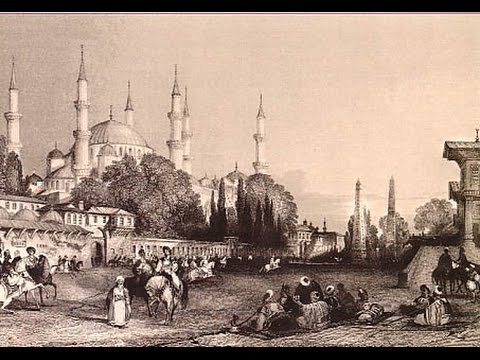
The OTTOMAN Empire map tracing | History and facts | ASMR whispered facts

These are just some of the key facts about the Ottoman Empire, which had a profound impact on the history of the regions it once controlled. Facts presented in a relaxing ASMR whispered video.
Foundation: The Ottoman Empire was founded around 1299 by Osman I, from whom it derives its name. It began as a small Anatolian state and grew to become a vast empire.
Location: The empire was located primarily in Anatolia (modern-day Turkey), but it eventually expanded to include parts of Europe, Asia, and Africa. At its height, it stretched from southeastern Europe to the Arabian Peninsula and North Africa.
Capital Cities: The Ottomans had several capital cities over the course of their history. Initially, it was Bursa, then Edirne, and finally Istanbul (formerly known as Constantinople) after its conquest in 1453.
Religion: The Ottomans were Muslims, and Islam played a significant role in their culture and governance. The empire practiced Sunni Islam, and the sultans held both political and religious authority.
Sultans: The Ottoman Empire was ruled by a series of sultans, starting with Osman I and ending with Mehmed VI in 1922 when the empire was dissolved. Some of the most famous sultans include Suleiman the Magnificent and Mehmed II (the conqueror of Constantinople).
Military Power: The Ottomans had a powerful military, which they used to conquer and expand their empire. Their Janissary Corps, made up of elite infantry units, was renowned for its effectiveness.
Conquests: The empire's expansion included the conquest of Constantinople in 1453, which marked the end of the Byzantine Empire. They also conquered much of southeastern Europe, parts of North Africa, and extended into Persia and the Arabian Peninsula.
Government: The Ottoman Empire had a complex bureaucratic system. The sultan ruled with the assistance of viziers and governors, and the empire was divided into provinces known as eyalets, which were further subdivided into districts.
Culture and Art: The Ottomans made significant contributions to art, architecture, and culture. They are known for their distinctive architectural style, including mosques, palaces, and public buildings. The famous Hagia Sophia in Istanbul was converted into a mosque after the Ottoman conquest.
Decline and Dissolution: The Ottoman Empire began to decline in the late 17th century and faced numerous challenges, including military defeats and internal strife. By the 19th century, it was often referred to as the "Sick Man of Europe." It finally dissolved after World War I, with the establishment of the Republic of Turkey in 1923 under the leadership of Mustafa Kemal Atatürk.
Legacy: The Ottoman Empire left a lasting legacy on the regions it once ruled, including the development of the Turkish language, architecture, and various cultural traditions. It also influenced the legal and administrative systems in some areas.
Population Exchange: After World War I, there was a significant population exchange between Greece and Turkey, resulting in the displacement of millions of Greeks and Turks from their respective countries.
Armenian Genocide: The Ottoman Empire is also remembered for the Armenian Genocide during World War I, in which hundreds of thousands of Armenians were killed or deported.
#asmrfacts #asmrhistory #historyfacts #asmrdrawing #asmrwhispering #ottomanempire #ottomansultans #ottomansultan #ottomanbattle #constantinople #asmrsoftspoken
This video contains ASMR trigers like:
- whispered words
- mouth sounds
- map tracing/drawing
- pen addnotations
- inaudibile whisperes
Last updated: